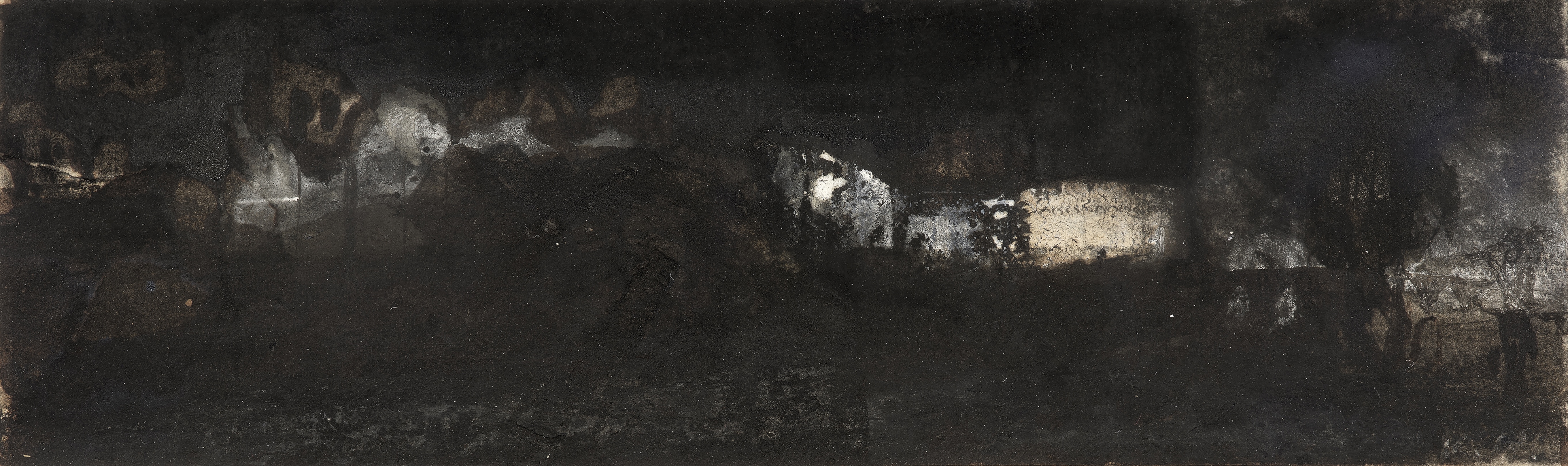
Between 1838 and 1840, Victor Hugo undertook three journeys through the Rhine region in the company of his lover, Juliette Drouet. These travels provided the direct inspiration for Le Rhin, published in 1842. The book is composed of fragments from the three trips, with the journey of 1840 at its heart. Hugo kept a detailed travel journal, which was complemented by notes in pocket books and in an album. The letters he sent to his wife Adèle, now preserved at the Bibliothèque Nationale de France, are illustrated with rapid sketches of landscapes. The album and notebooks contain numerous drawings, often topographical, though it is not always possible to distinguish precisely between real sceneries and imagined landscapes. This ambiguity in Le Rhin material, created between Notre-Dame de Paris (1831) and Les Misérables (1845), marks a crucial stage in Hugo’s development.
The album that documented his excursions along the banks of the Rhine originally contained 42 sheets, of which 35 remain today, while the 1840 notebook is a composite of pocket diaries and loose sheets recorded in the inventory of the notary Gustave Gâtine. Our drawing belongs to this Rhine series and was probably part of the original album. At the threshold between figuration and abstraction, a town and the arches of a bridge can be discerned as they dissolve into a nocturnal fluvial landscape. Figurative elements surface within what André Breton called Hugo’s “ink stains”. The drawing is characteristic of Hugo’s distinctive technique, in which forms emerge from a mist of ink and wash, and in which the deliberate application of inkblots on the sheet invites imagination to shape the composition. In the manner of his writing, drawing here becomes a means of reading reality and of capturing fleeting visions of water, of a bridge, and of wooded banks by connecting them to the poet’s inner reverie.
Our sheet is part of the collection of the descendants of Paul Meurice, a playwright and close friend of Hugo. During the 18 years of exile, Meurice was the artist’s trusted confidant and ambassador in Paris: he managed the publication of Hugo’s works, his contracts, and the scheduling of plays, all while pursuing his own career. When Hugo returned to Paris, he moved into Meurice’s home and appointed him the executor of his literary estate. During his lifetime, Meurice owned the largest and most significant collection, both in quantity and quality, of Hugo’s drawings.