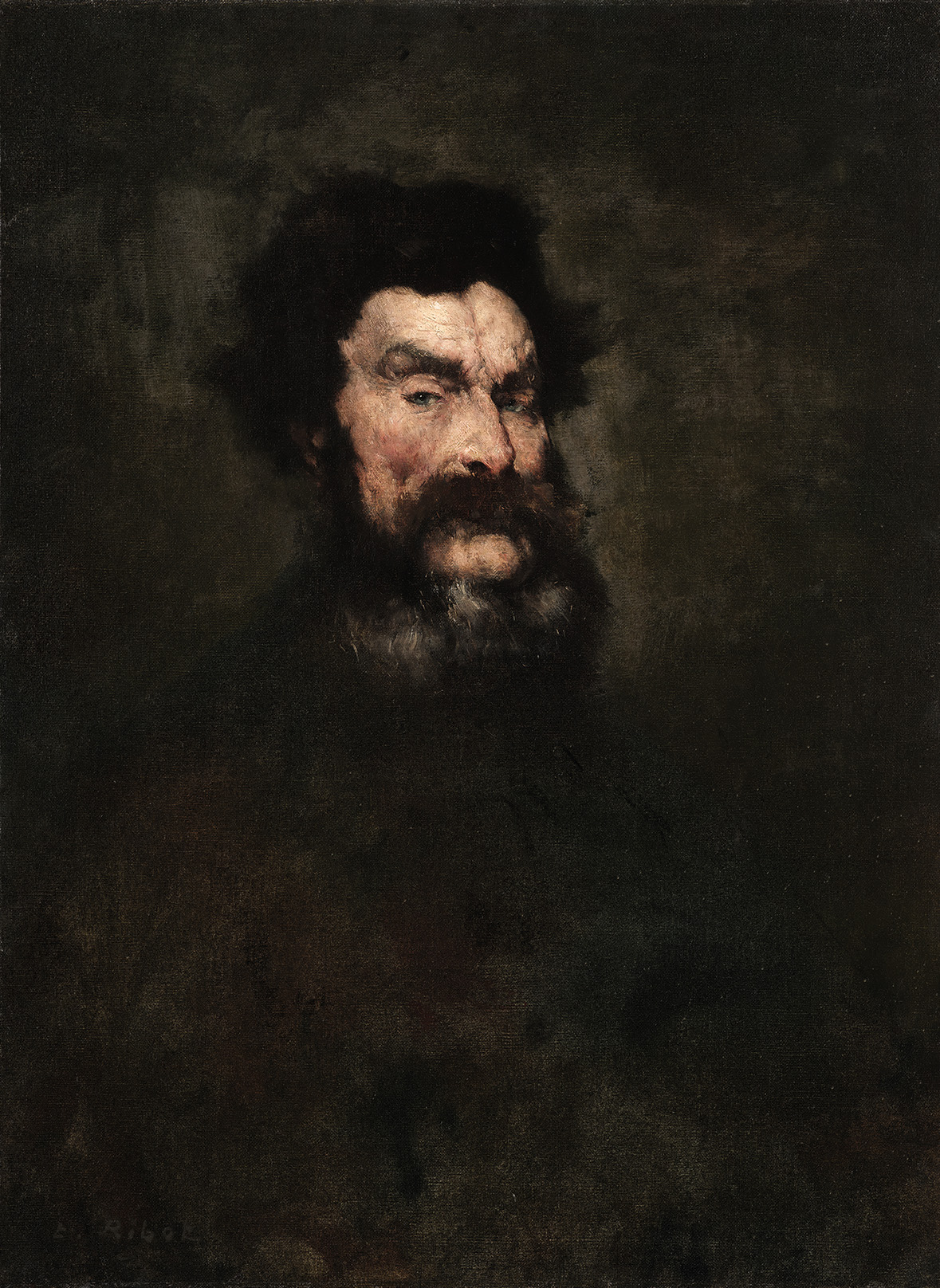
Ribot’s ability – especially in the later stages of his career – to confer a sense of presence on even the most ordinary individuals distinguishes his work from that of more conventional portrait painters of the period. Le Père Bresteau, conceived in the manner of Ribera, exemplifies the psychological complexity and technical quality of his portraiture. An older man emerges from darkness, his rugged features lit to emphasise his physical and emotional gravitas. The dramatic chiaroscuro that invades the canvas recalls the Spanish Baroque masters Ribot admired while underlining the sitter’s inner life.
Le Père Bresteau, a portrait of a fisherman from Brittany, was exhibited in 1887 at the Galerie Bernheim-Jeune. His representation reappears in the group composition Breton Fishermen and Their Families (fig. 1), now in the Metropolitan Museum of Art in New York. Shown alongside the portrait of his daughter Marie en buste, the painting revived one of Ribot’s central themes, notably the contrast between youth and old age that lies at the heart of his double portraits and of many of his multi-figure compositions.
Although the work received little press coverage, the few notices it did attract commented on the unexpected vigour of the paternal figure, which took both the artist’s admirers and detractors by surprise. In the Journal des artistes of 16 May 1886, Jean Lefurtec – a Breton critic sympathetic to Ribot’s sitters – described the portrait of Père Bresteau as “an extremely characteristic figure. Here the master has departed from his usual model. His brush has extended its strokes in the direction of the line, obeying the artist’s concern above all to render the character of the face, which is very strongly emphasised.” Le Père Bresteau stands apart from the more restrained procession of Ribot’s portraits. The catalogue of the 1887 Bernheim-Jeune exhibition, where the painting was displayed, also recorded that it had been lithographed by Camille Victor Vergnes.