Stanley Spencer was born in Cookham, Berkshire, a village that would remain a constant visual and spiritual reference throughout his career. Trained at the Slade School of Fine Art from 1908 under Henry Tonks, he received a rigorous academic formation based on drawing from the live model. This discipline fostered an intense, lifelong engagement with the human figure, which became one of the most radical and revealing aspects of his practice. His work gained early recognition and he emerged as one of the most distinctive and celebrated figurative painters in Britain: he was elected a Royal Academician, awarded a CBE, and knighted in 1959, the year of his death.
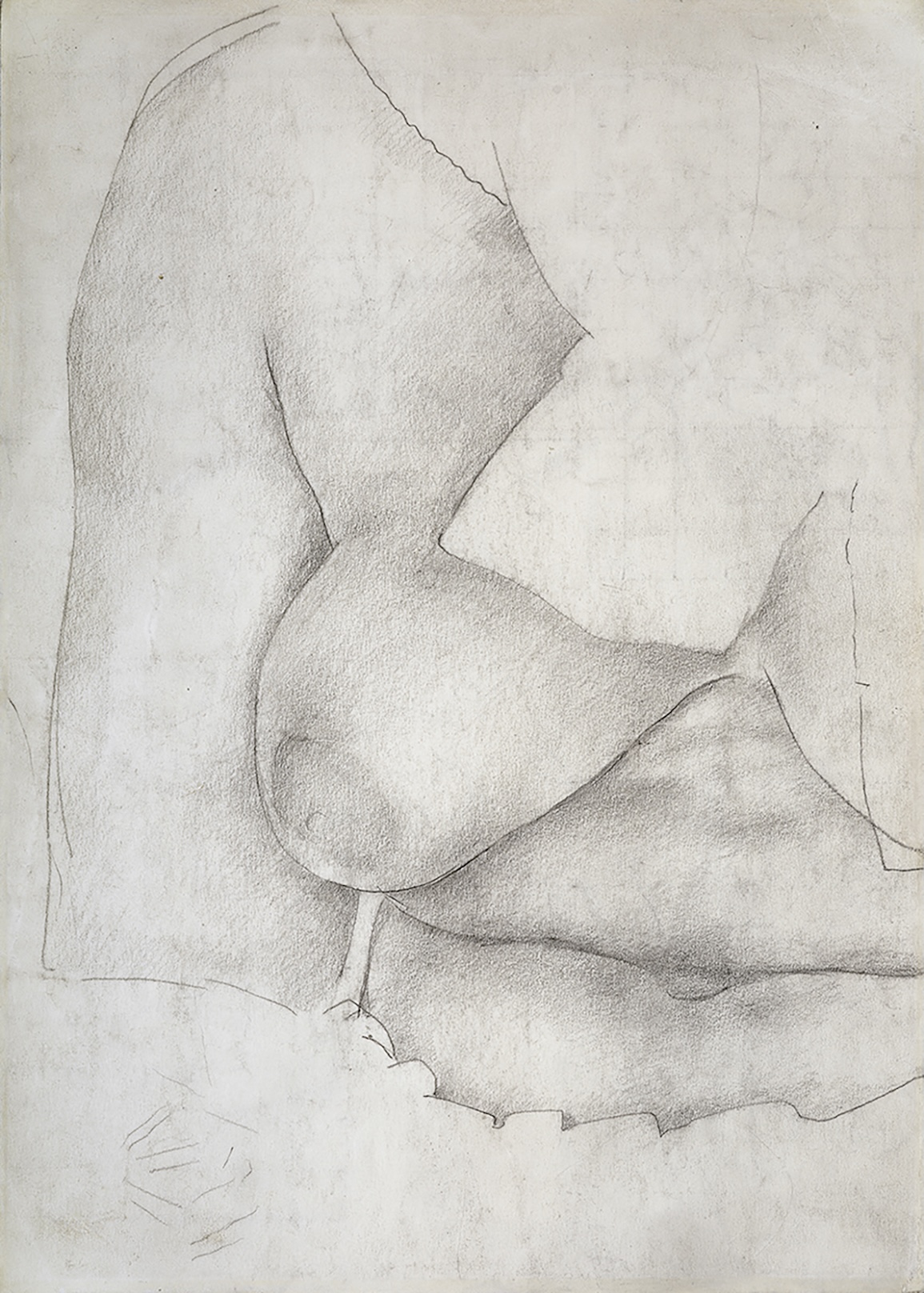
Far from academic idealisation, Spencer developed an uncompromisingly direct realism. His nudes, which feature among the most striking in 20th-century British art, are rendered with a frankness that foregrounds physical heft and vulnerability. Flesh, observed closely and unsparingly, is imbued with psychological presence. This approach reaches a culmination in works such as his Nude Portrait of Hilda, which is insistently and crudely real and intimate. Our Female Nude exemplifies this sustained commitment to truthful observation from life and may plausibly be understood as a study related to this body of work, whether for the celebrated Nude, Portrait of Patricia Preece (1935) (fig. 1) held in the Ferens Art Gallery, or for a comparable painted nude. Cropped tightly on the torso and arms, the composition deliberately avoids narrative and individual likeness, concentrating instead on compression and curvature. The omission of the head further intensifies the focus on the body as a subject of analytical scrutiny, underscoring the intimate and probing nature of Spencer’s art.
On the verso (fig. 2), the sheet bears a series of squared studies that reveal Spencer’s method of enlarging compositions for transfer to canvas. These relate to several paintings executed around 1940, notably The Coming of the Wise Men and On the Tiger Rug, and highlight the central role of drawing as both an investigative and preparatory tool in his work. Spencer’s treatment of the body as dense, exposed, and unidealised, anticipates the realism of Lucian Freud, who acknowledged his role as a crucial precursor.
