Pablo Picasso met the photographer Dora Maar, born Henriette Theodora Markovitch, during the International Surrealist Exhibition held in Santa Cruz de Tenerife in the spring of 1935. From this encounter developed a sustained personal and artistic relationship, in which Maar – soon to become one of Picasso’s principal models – engaged with the artist in a fertile exchange between photography and painting. Picasso was drawn to Maar’s intellectual independence and assured presence. Their relationship unfolded alongside his ongoing connection with Marie-Thérèse Walter, the mother of his daughter Maya.
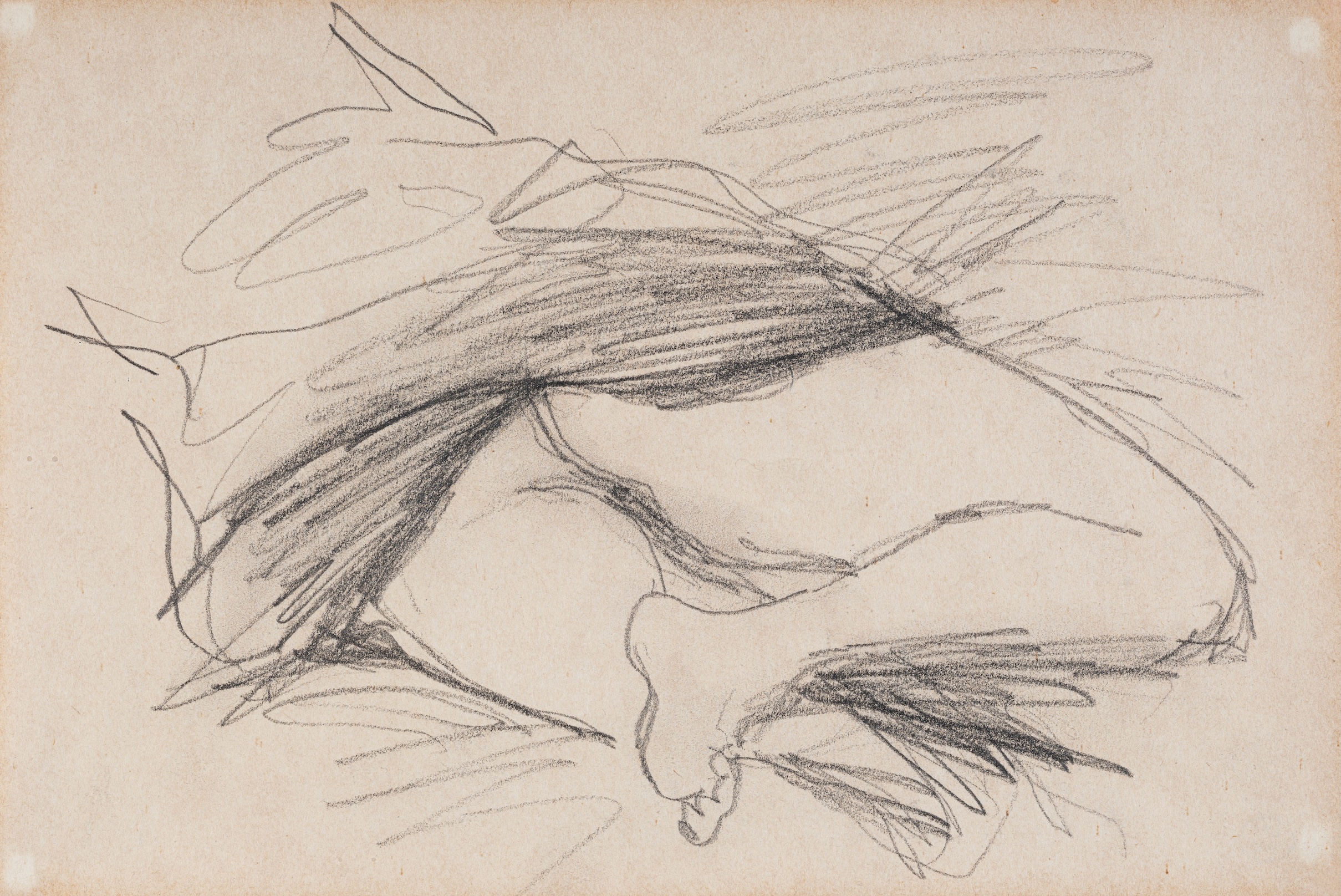
Our drawing comes from a sketchbook belonging to Maar and dating from the 1930s. The carnet contains several drawings by Picasso, including studies and a written note referring to Ferdinand Cheval, the celebrated Facteur Cheval, whose visionary Palais Idéal – built single-handedly between 1879 and 1912 – became an emblematic example of imaginative, self-taught architecture admired by avant-garde artists and Surrealists. Executed in 1937, the same year as Guernica, the present sheet was conceived during a period of exceptional intensity in Picasso’s work. In our Study of the Legs of Dora Maar, Picasso sketches the semi-open legs of his reclining companion. A lightly indicated drapery partially covers her body, while the composition remains suggestive through its economy of line and detail. Picasso’s remark that “art is never chaste” finds a discreet echo in this sheet, conveyed with restraint and understatement.
The confident, uninterrupted pencil strokes reveal Picasso’s close attention to form and posture, as well as his ability to translate a private moment of observation into a drawing of striking immediacy. The sheet stands as a compelling example of Picasso’s draughtsmanship in the late 1930s, combining intimacy, clarity of vision, and formal control.