Marguerite Gabriel-Claude, better known as Marguerite Sérusier, was a French artist and professor active in Paris in the early 20th century. After studying at the École des Beaux-Arts in Paris, she began her professional career teaching drawing in Montargis before becoming a professor within the schools of the City of Paris. In April 1909, she enrolled at the Académie Ranson, where she met Paul Sérusier – one of the leading figures of the Nabis – and dedicated herself to tapestry and embroidery. Following her marriage to Sérusier in 1912, she moved to the small town of Châteauneuf-du-Faou, in Brittany, where she pursued her interest in floral motifs and in the decorative arts.
After her husband’s death in 1927, Sérusier played a central role in preserving and promoting his artistic legacy. After settling in Châteauneuf-du-Faou in 1933, she undertook an extensive programme of documentation and dissemination of his work, multiplying exchanges with Maurice Denis, participating in exhibition projects, and opening a Paris studio at 8 rue Falguière in support of this endeavour. At the same time, the artist maintained an autonomous practice within the shared creative environment of the Nabis, particularly in its emphasis on decoration and the integration of art into everyday life. Drawing inspiration from forest plants, mosses, and marine grasses, she created several designs for carpets, screens, and other decorative elements. This attention to surface and pattern aligns with the Nabi interest in the decorative arts, which is visible in contemporaneous works such as Paul Sérusier’s Tapisserie, also known as Les Parques. As Denis observed, in Châteauneuf-du-Faou Marguerite devoted herself to decorative research, translating botanical observation into ornamental compositions.1 Working in close collaboration with her husband within the studio, she contributed to the sophisticated decorative projects (fig. 1) and encouraged Sérusier’s move towards mural painting as they undertook the decoration of their home.
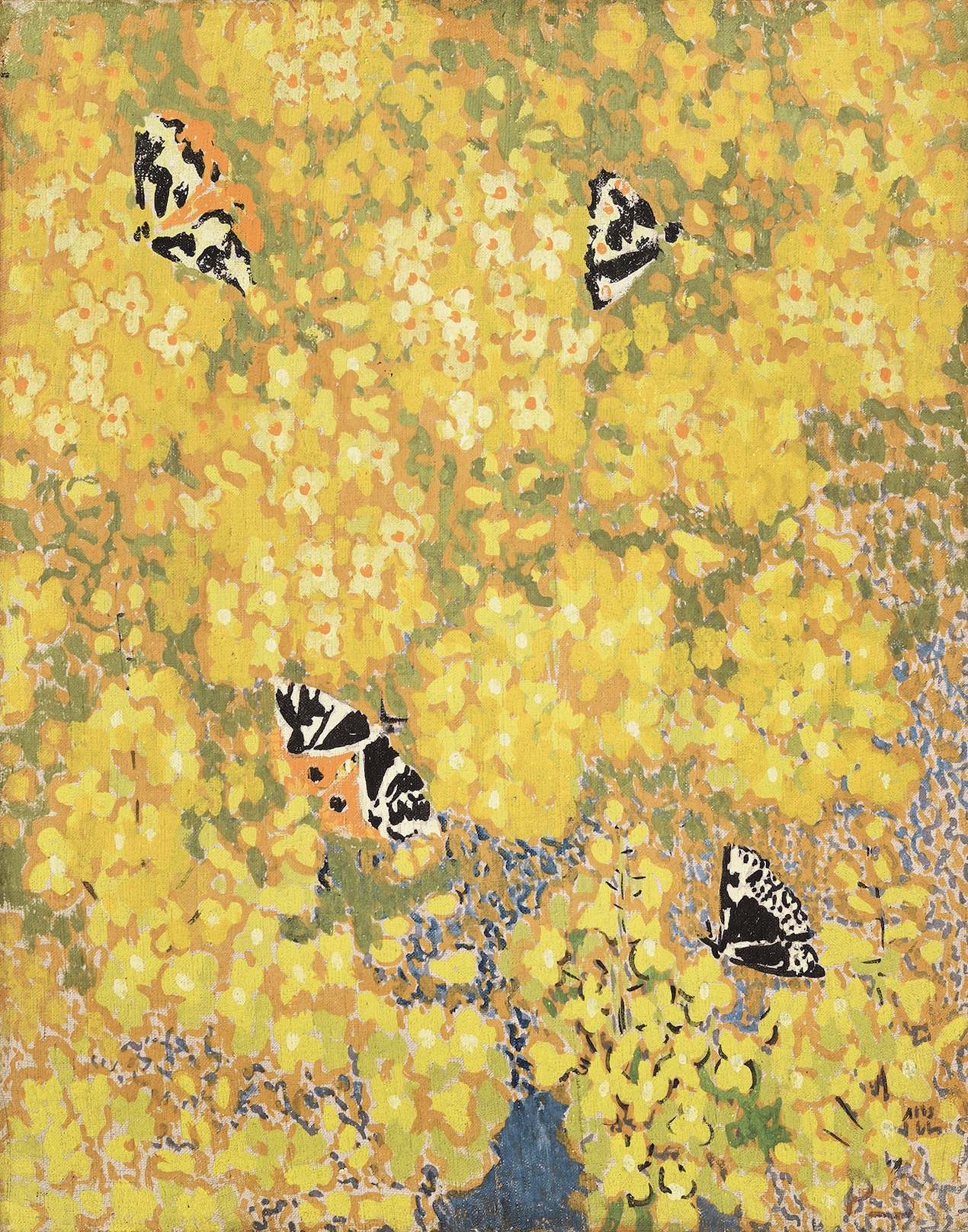
In our composition, the profusion of stylised blossoms and butterflies is organised across the surface in a manner characteristic of the Nabi pictorial language, privileging pattern over depth and dissolving the distinction between the elements and their surrounding environment. The flattened field of yellow flowers recalls the aesthetics of tapestry and textile design while the butterflies, rendered in simplified black, white, and orange brushstrokes, reinforce the image’s affinity with woven or printed fabric. The studio stamp of Paul Sérusier was applied to the canvas during the vacation of the Sérusiers’ studio. This misapplication testifies to the close stylistic affinity and comparable quality of their works, while also underscoring how Marguerite’s production has long remained in the shadow of her husband’s name.