Jean-François Millet devoted his career to the Realist representation of rural labour, treating the daily work of peasants as a subject of enduring seriousness. Having trained in Cherbourg and Paris before settling in Barbizon in the late 1840s, he repeatedly returned to scenes of sowing, digging, and harvesting, as he regularly drew on his intimate knowledge of agricultural life to construct images grounded in physical effort and collective gesture.
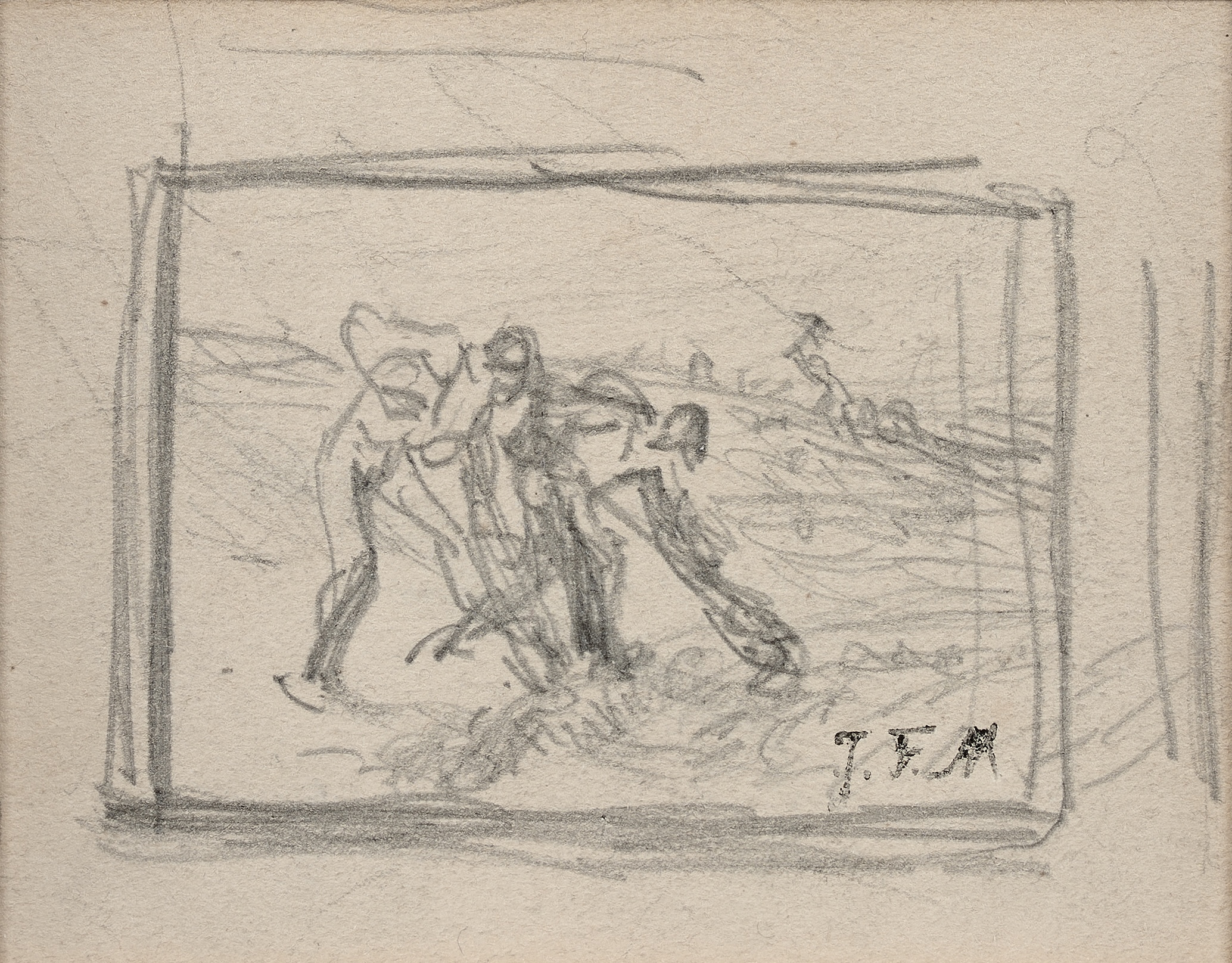
Drawing allowed Millet to develop his compositions in successive stages, often beginning with rapid, searching sketches before moving toward more resolved drawings or paintings. Our sheet offers the representation of two figures bent forward as they work the ground, their bodies aligned in a shared, rhythmic motion. It constitutes an initial conception for a more finished drawing of diggers executed around 1855 and now held in the collection of the Clark Art Institute (fig. 1), in which the figures are more fully modelled and securely anchored within space. Drawn with quick, forceful strokes, our early study focuses on gesture and physical effort and transforms a humble agricultural task into a concentrated image of labour and persistence. On the verso, a small charcoal study isolates the bent elbow of the figure on the left while also anticipating the more resolved treatment of the same arm in the Clark drawing, where it is fully integrated into the final composition.
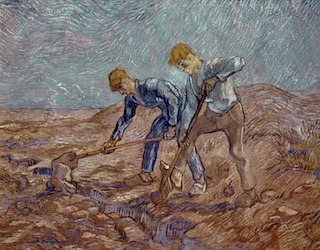
Millet revisited this scene in numerous distinct versions, which were later disseminated more widely through engravings. Our composition was ultimately copied by Vincent van Gogh, who reinterpreted it in his own distinctive style (fig. 2).