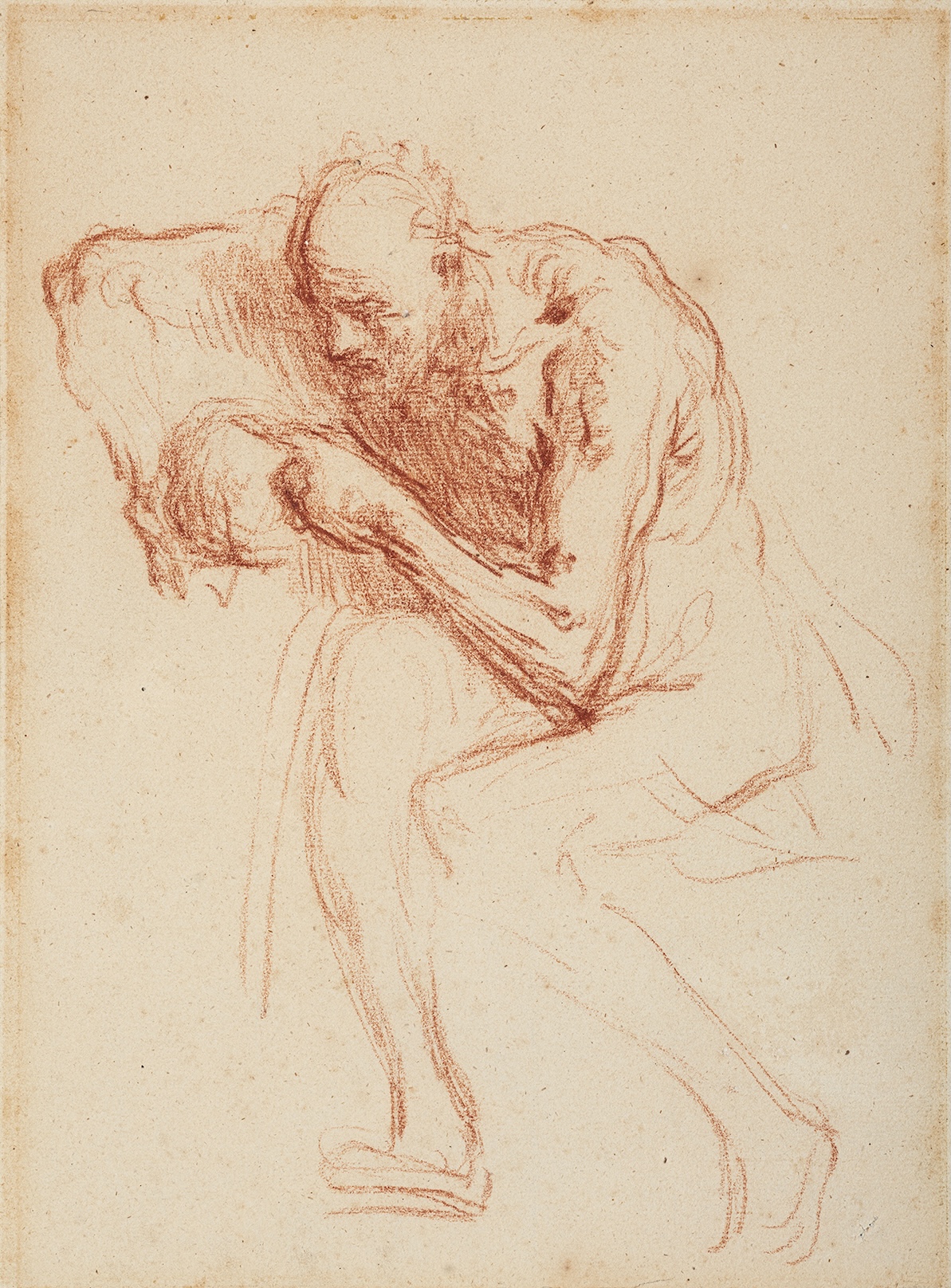
Paintings and drawings of religious subjects are rare in Jean-François Millet’s œuvre. Among the most ambitious of these early works is The Temptation of Saint Jerome, submitted to the Salon of 1846. The painting was refused and, in the following year, Millet cut the canvas to reduce its size and reused it to paint Œdipus Taken Down from the Tree (fig. 1), held in the National Gallery of Canada, in Ottawa, thereby effacing the original composition.
Only two preparatory studies for the painting The Temptation of Saint Jerome are known: one sold at Christie’s, Paris, at the sale Dessins Anciens et du XIXe Siècle, 21 March 2018 (lot 120), and our drawing. More exploratory in character, our sheet records Millet’s first thoughts on the subject, before the composition was further elaborated.Executed in red chalk – a medium used only sparingly by Millet and therefore particularly noteworthy within his graphic œuvre – the drawing is marked by the expressive power of the Saint’s head. As claimed by Alfred Normand, who owned the drawing in the 20th century, in his inscription on the verso of the drawing, “this is one of the very rare red chalk drawings by the artist, who only made ten or so at most. It is comparable to a Tiepolo or a Rembrandt”. Indeed, the compositional vividness and nervous use of red chalk lend the sheet a distinctly Rembrandtesque character which recalls the chiaroscuro effects of 17th-century Dutch painting admired by Millet.
In the absence of the painted version of the composition – of which only the head of the Saint can be discerned in the X-radiograph of the canvas held in Ottawa – our drawing offers rare insight into Millet’s creative process at a formative moment in his career and stands as a unique witness to a project otherwise known only through fragmentary evidence.