From the outset, Whistler’s career was shaped by displacement and cultural hybridity. Born in the United States, he spent his formative years in Saint Petersburg, where he received his earliest artistic training, before returning to America in his late teens. In 1851 he enrolled at the United States Military Academy at West Point. Although his time there was brief, these years proved artistically productive.
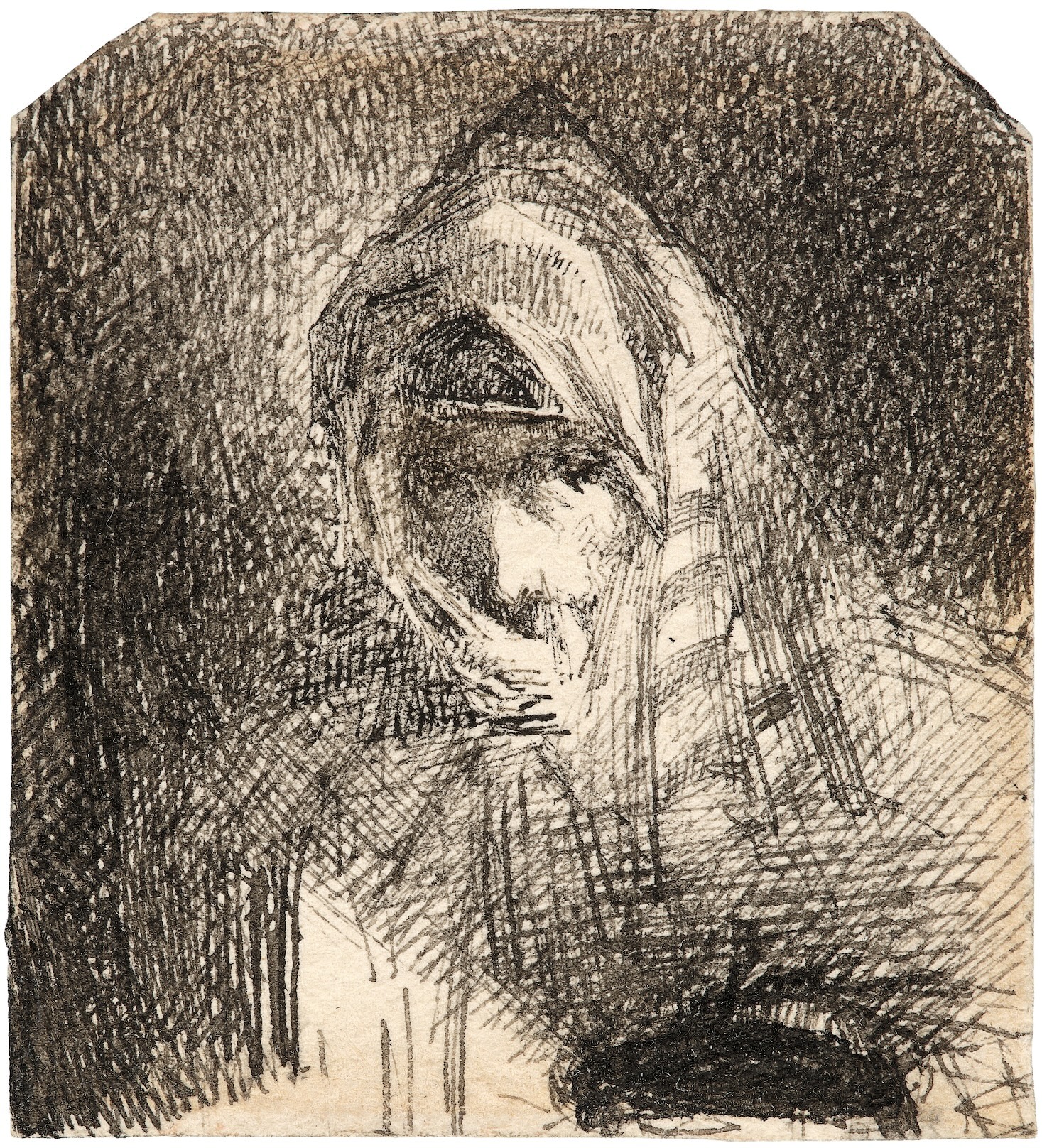
Even before receiving formal training in Europe, he used pen and ink as a direct, exploratory medium to study form, light, and expression. Our sheet, executed during his time at West Point, exemplifies this early concern with psychological presence and tonal structure. The head emerges from dense cross-hatching, its features built through closely layered strokes. Partly concealed beneath the folds of the turban, the sitter’s shadowed gaze and indistinct features lend the figure an exotic, orientalising character that heightens its mystery. Delicate pen work creates an almost lantern-like illumination around the head, while the paper’s slight grain enhances its atmospheric depth. Through its small scale, the drawing achieves a striking dramatic presence.
Like many drawings produced at West Point, the sheet may have served as an illustration or character study. It may relate to a group of larger compositions from the same period depicting men with shoulder-length hair, moustaches, and beards, often wearing caps or hoods and sometimes shown in interiors suggestive of historical or literary subjects. Although the precise context remains uncertain, the drawing belongs to this early narrative phase of Whistler’s activity. At this time, the artist also seems to have isolated figures from larger compositions by cutting the paper around them, effectively framing the character within the sheet itself. The format of our drawing reflects this practice, transforming what was once part of a broader composition into a self-contained and compelling study.
Whistler gifted our Head of a Man in a Turban to Maria Whitman Bailey, the daughter of Professor Jacob Whitman Bailey, a scientist and professor at the Military Academy with whom the artist was closely acquainted.