Born in Paris into a family of artists, Georges Rasetti trained at the École des Beaux-Arts and studied under Léon Bonnat and Florent Willems. In 1891, he travelled to Pont-Aven, where he encountered Paul Gauguin and became closely associated with Paul Sérusier, as well as with Aristide Maillol, Charles Filiger, Jan Verkade, and Mogens Ballin. This period placed him at the heart of the Nabi circle, at a moment when the group was formulating a new pictorial language based on synthesis, structure, and on the expressive autonomy of line and surface. Rasetti’s work from the 1890s reflects the Nabis’ rejection of naturalistic description in favour of compositional rhythm and symbolic resonance.
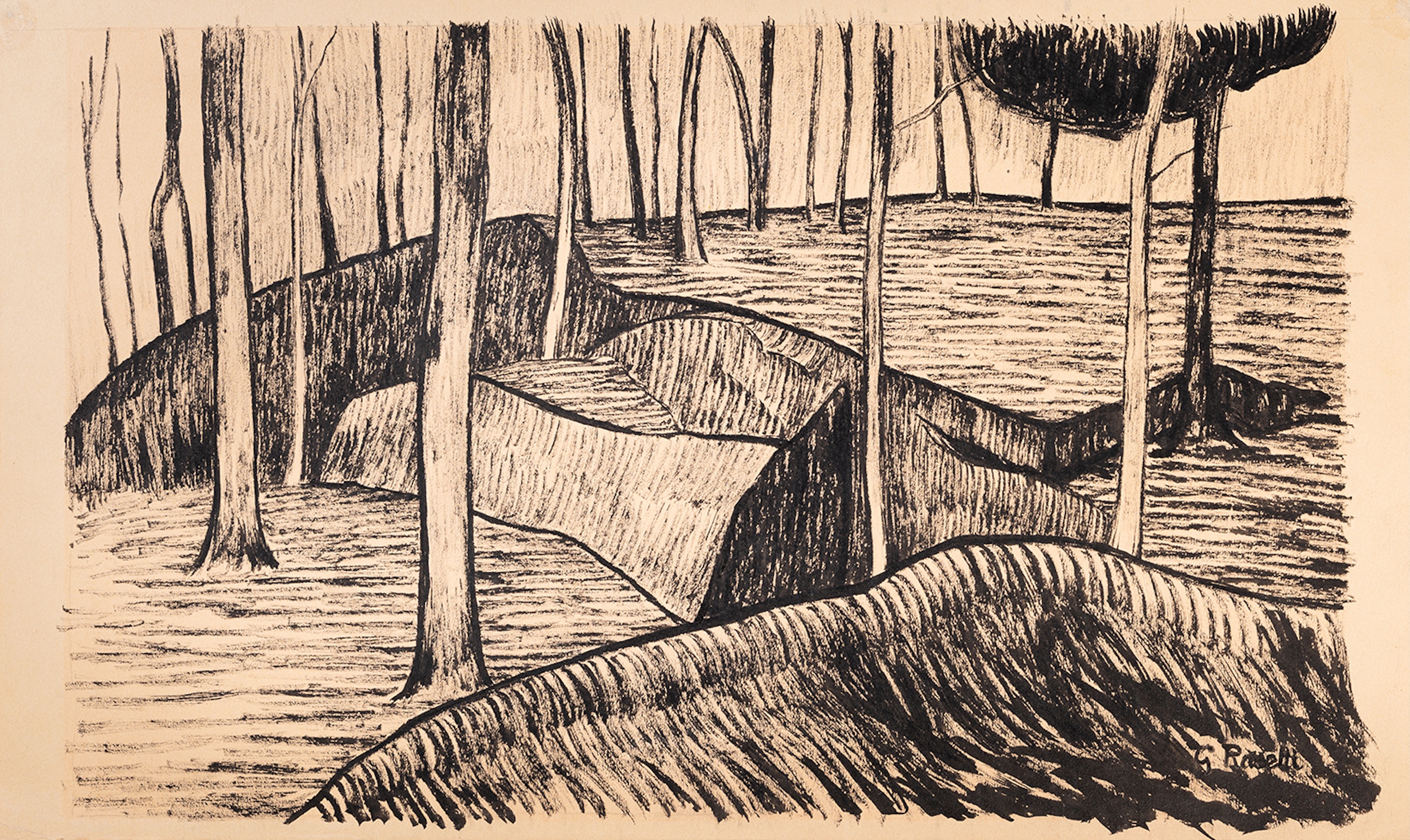
Alongside painting, Rasetti was deeply engaged with printmaking and ceramics, practices that reinforced his interest in line and graphic clarity. His drawing technique, which was strongly influenced by Japonisme and by the aesthetics of woodcuts, favours contour, repetition, and areas of dense hatching evoking the visual logic of engraving.
The motif of the wood or forest holds particular significance within Nabi imagery, where it is associated with introspection and spiritual retreat. Its dense, enclosed structure allowed Nabi artists to suppress perspectival depth and descriptive detail, favouring instead a synthetic organisation of vertical forms and flat colour planes through which paintings and drawings could convey inner experience. Our Wooded Landscape, executed in black ink on paper and dating from this formative Nabi period, exemplifies these concerns. The composition is organised through a succession of vertical tree trunks set against simplified ground forms and articulated by dense, directional hatching.
Rasetti’s œuvre is today exceptionally rare, owing in part to his premature death in 1938 following a fire in his studio, which is reported to have destroyed a substantial portion of his work. Nevertheless, despite the limited dissemination of his production during his lifetime and its subsequent scarcity, Rasetti occupies a significant position within the history of the School of Pont-Aven, as he participated in the movement’s emergence and contributed actively to the experimental climate from which Nabi aesthetics first took shape.