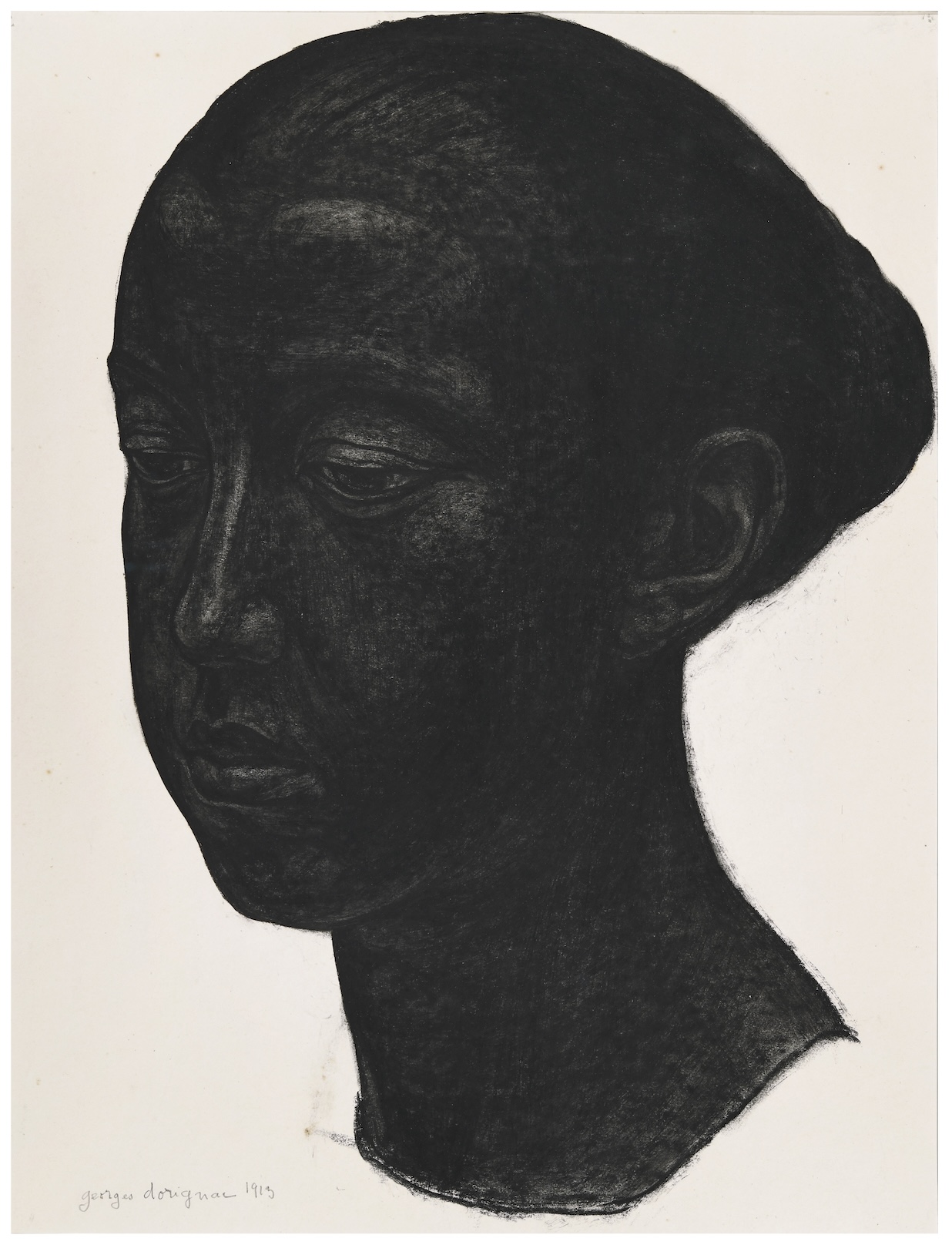
Georges Dorignac occupies a singular position within the Parisian avant-garde of the early 20th century, owing to his radical rethinking of drawing as a sculptural and expressive medium. After training at the École municipale des Beaux-Arts in Bordeaux, he moved to Paris around 1900 and entered the studio of Léon Bonnat. His early years were marked by stylistic experimentation which, around 1905, culminated in the creation of Impressionist and Neo-impressionist works. A decisive turning point came in 1911 with the artist’s move to La Ruche, a vibrant artistic hub in Montparnasse, where he formed close relationships with, amongst others, Amedeo Modigliani and Chaïm Soutine. There, Dorignac developed his figures noires et rouges, the monumental black and red chalk drawings that defined his mature period.
Executed in 1913, our Portrait of Georgette, the Artist’s Daughter, belongs to this pivotal momen in Dorignac’s career. Using charcoal with exceptional density and control, he constructs the head almost entirely through black mass, allowing form to emerge through subtle modulations of pressure. The face is modelled as if carved from shadow, recalling sculptural relief while demonstrating Dorignac’s ambition to endow drawing with the physical presence of sculpture. While Dorignac often applied this technique to anonymous or archetypal figures, the choice of his daughter as a model lends the drawing a particular intimacy. The inward gaze and restrained pose reinforce the timeless and monumental character of the image, which is one of his most accomplished. This synthesis of personal subject matter and radical formal language is characteristic of Dorignac’s work during these years and underscores the originality of his contribution to modern drawing. The Portrait of Georgette stands as a key example of Dorignac’s ambition to elevate drawing to rival painting and sculpture in expressive power.