After studying architecture at the Royal Academy of Fine Arts in Ghent, George Minne soon turned away from academic training to pursue an independent artistic path. He exhibited at the Ghent Salon in 1889 and at the Salon des XX in Brussels the following year. During a stay in Paris in 1891, he received encouragement from Auguste Rodin, whose naturalism he deeply admired. Closely associated with Symbolist circles – notably the poets Maurice Maeterlinck and Émile Verhaeren – Minne exhibited at the first Salon de la Rose + Croix in 1892. Throughout the 1890s, he developed the motif of the nude, a theme he would repeatedly revisit in sculpture. Borrowing from Rodin the principle of variation and repetition, Minne refined an art marked by mystical primitivism, the primacy of line, and an increasingly radical simplification of form.
A prolific draughtsman, Minne conceived drawings not merely as preparatory studies but as autonomous works that reveal the same concerns that permeate his sculpture: inwardness, emotional concentration, and bodies held in states of tension or repose.
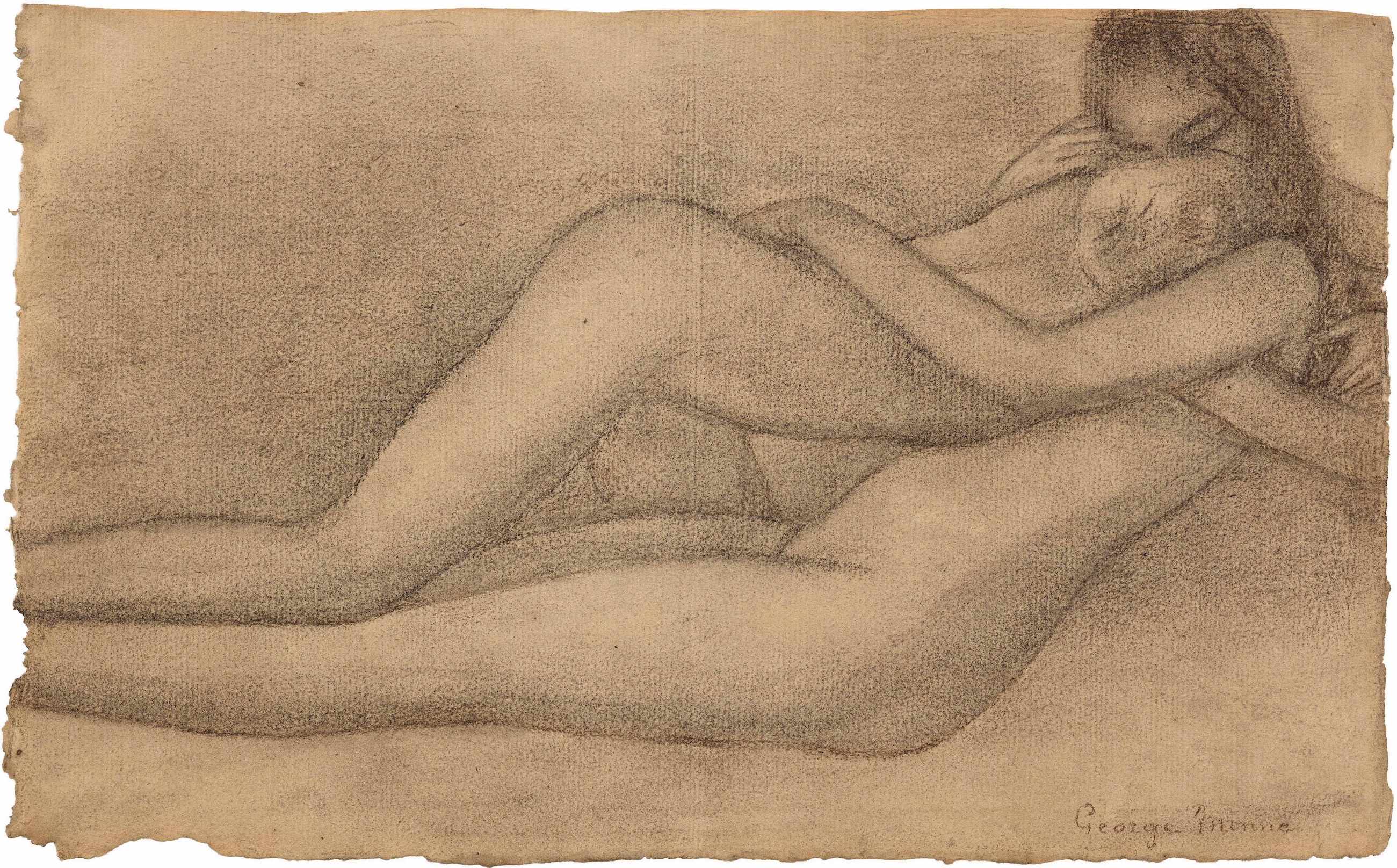
Our sheet, executed in the 1920s, revisits the motif of the Embracing Couple, which he explored in his drawings as well as in his sculpture since the early stages of his career. The intertwined figures continue to articulate themes central to his œuvre: physical tension, inwardness, and compressed movement, with the forward-inclined male figure recalling the expressive idiom of Rodin, notably in Ugolino (1882).
Rendered in rich, velvety black chalk, our Embracing Couple reflects the softened graphic language characteristic of Minne’s later career.