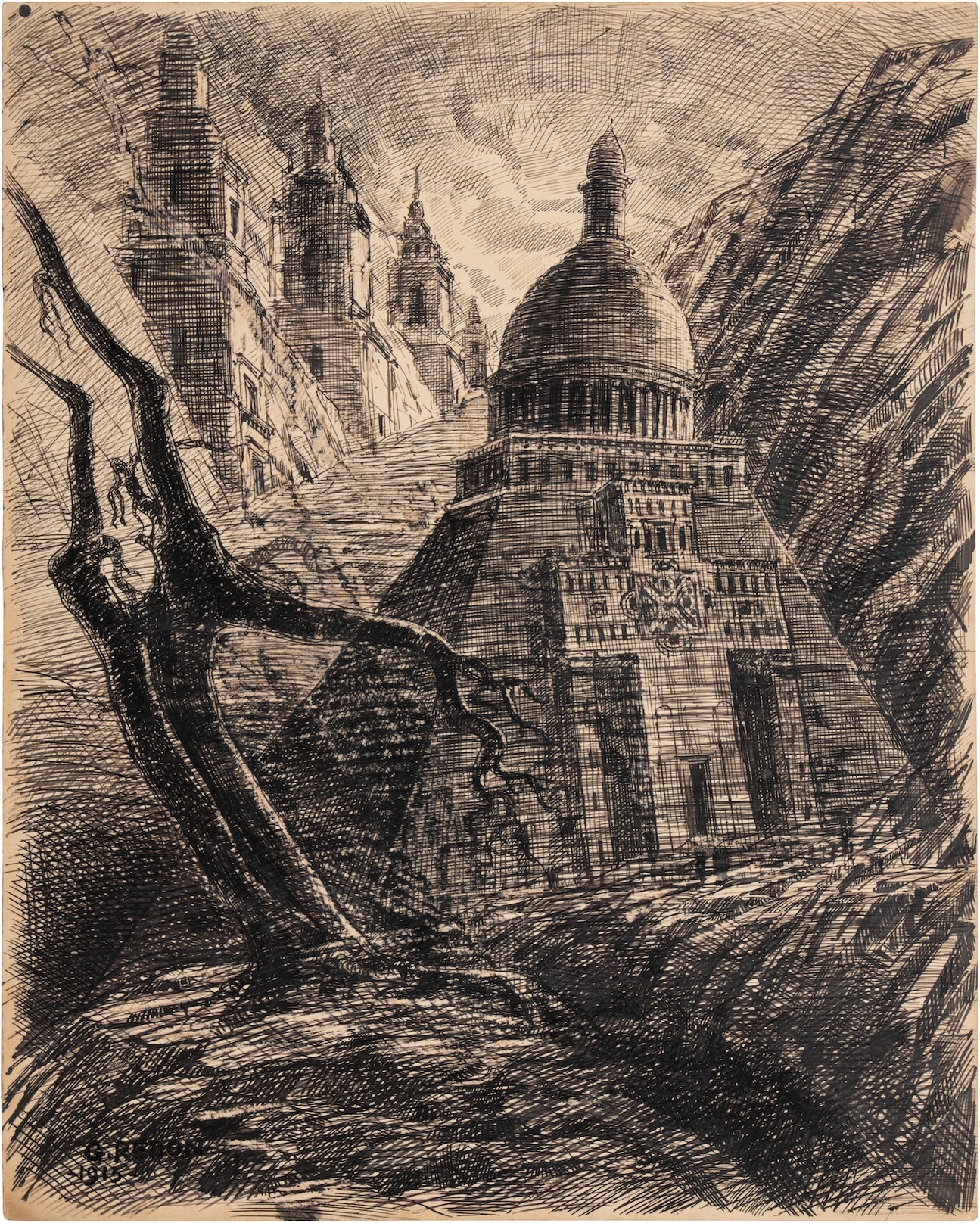
Brother of the famous painter Odilon Redon, Gaston Redon is primarily known as an architect. Admitted to the École des Beaux-Arts in 1883, he won the Prix de Rome that same year and entered the Villa Medici as a resident. In Rome, he formed friendships with composers Claude Debussy and Gustave Charpentier, who were also residents at the time.
Deeply uninterested in conventional architecture, Redon quickly turned away from academic practice to explore, through drawing, entirely imagined architectural visions. His graphic work, which included several studies of monumental and unreal architecture, enabled the artist to express his search for the infinite and the unattainable.
Our sheet, with its eerie and fantastical atmosphere, combines the artist’s prowess as an architect and a draughtsman with his passion for music. Possibly a visual transcription of the macabre compositions of Franz Liszt (such as Nuages gris from 1881 or Pensée des morts from 1834–1852), or the Erlkönig that Franz Schubert composed in 1815 based on the famous Romantic poem by Goethe titled Der Erlkönig (The King of the Elves, 1782), our architectural scene illuminate Redon’s ability to transcribe these musical pieces’ sense of anguish into his technically advanced drawings.1 Our Fantastical Landscape, recalling the phantasmagorical visions of his brother Odilon, is distinguished by its refined crosshatching, which lends depth and structure to the pyramidal – perhaps sacred – architecture boldly rendered on the sheet. At the same time, the composition conjures an atmosphere of the uncanny, a concept that preoccupied many scholars and psychiatrists at the turn of the century.
1 Les Arpenteurs de rêves: dessins du musée d’Orsay, exh. cat., Evian and Quimper, 2022, p. 128.