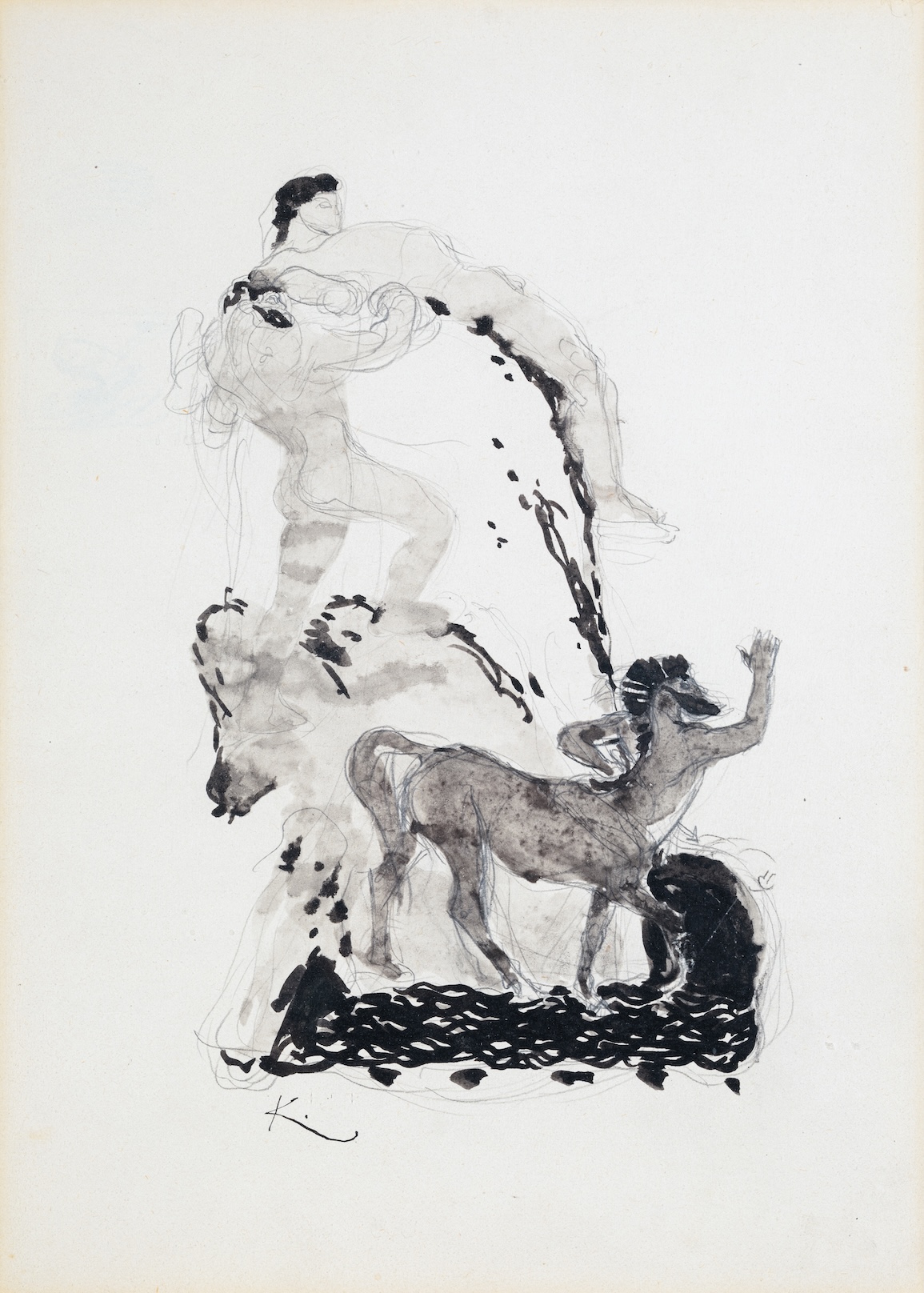
Around 1905, František Kupka deepened his engagement with ancient civilisations, an interest stimulated by his work as an illustrator for Élisée Reclus’ L’Homme et la Terre (1905 to 1908). This immersion in the origins of humankind subsequently informed his major Greek projects, including Les Erinnyes after Leconte de Lisle (1907), Lysistrata by Aristophanes, and Prometheus after Aeschylus, a theme he explored repeatedly before 1910 (fig. 1). Our wash drawing belongs to Kupka’s early figurative period, when mythological subjects provided a fertile ground for narrative invention, symbolism, and formal experimentation, several years before he emerged as one of the foremost pioneers of abstraction.
In our composition, the titan is chained to a rock, surrounded by hybrid beings and a bird of prey, within a vertical composition of striking dramatic intensity. Kupka adopts a deliberately archaising idiom, combining monumental bodies, mythological figures, and fantastic creatures to evoke the primordial atmosphere of the myth. Rather than illustrating Aeschylus directly, the image draws on the visual imagination of pre-classical art, where monsters and humans coexist in an undifferentiated mythic world. The abrupt morphology and tense anatomy reflect Kupka’s search for primal forms and for a visual language liberated from academic convention.
Our Prometheus was in the collection of Claude Pompidou, wife of the French President Georges Pompidou and a noted art enthusiast, whose collection reflected a sustained interest in major currents of modern art.