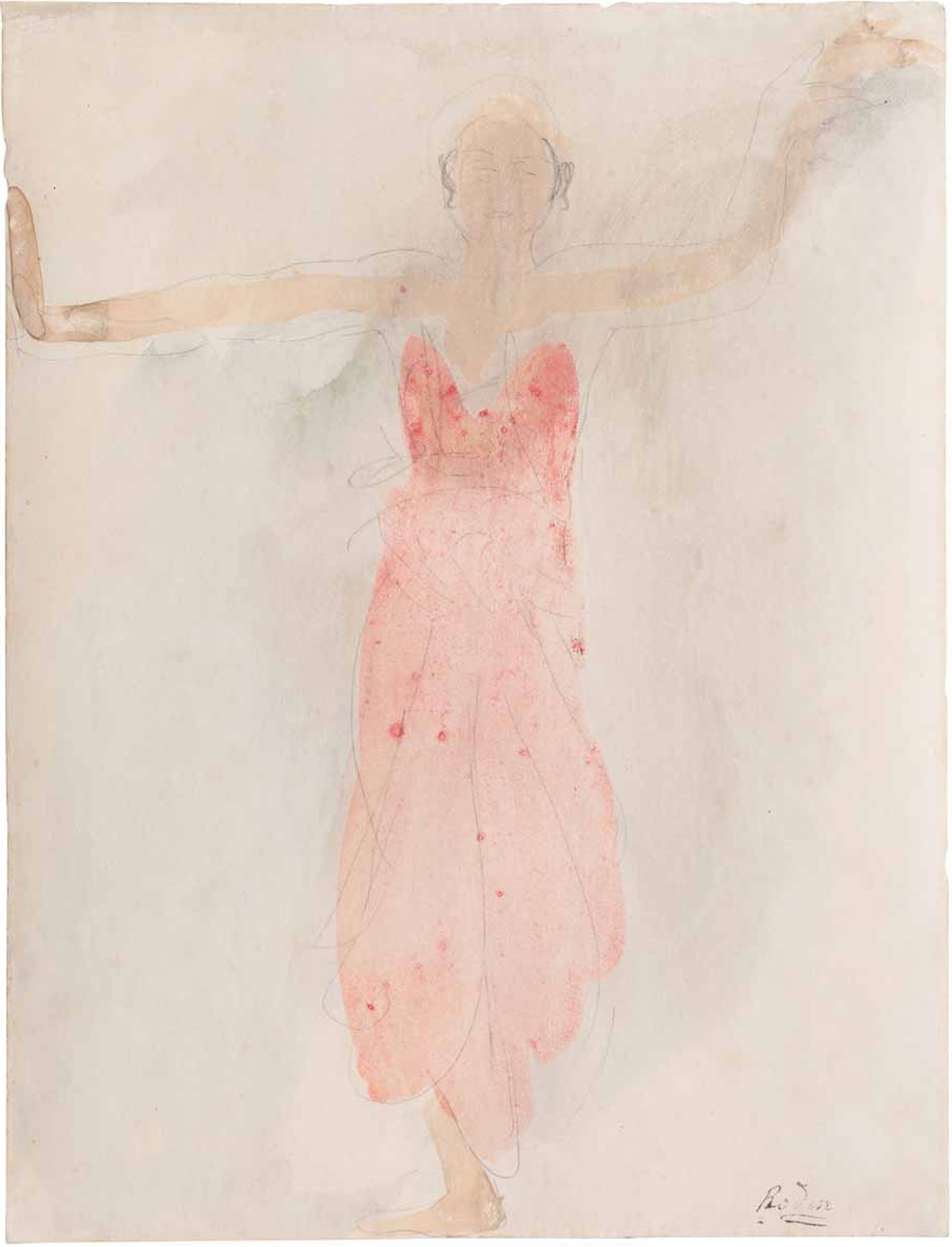
Auguste Rodin’s fascination with the Cambodian dancers began in 1906, when the Royal Cambodian Ballet performed in Paris during an official visit of King Sisowath. The dancers, with their highly stylised, fluid movements, and distinctive, almost sacred forms, captivated Rodin, who was deeply moved by their gestures and the combination of grace and ritual in their performances. Far from seeing them through a lens of sensuality, Rodin admired their physicality as a profound expression of art and form.
While sculpture, which had brought him fame in France and internationally, remained his primary medium, it was in his drawings that Rodin explored his newfound obsession with the dancers, whom he followed to Marseille, where they pursued their French tour. The intimacy of the connection he formed with the Cambodian performers was deeply personal, and he sought to capture their essence in a way that went beyond mere representation. The encounter with the dancers marked a pivotal moment in Rodinʼs career, inspiring some of his most original final works.
Our sheet, the Cambodian dancer balances lightly on one foot, her elongated arms flowing gracefully through the air. The soft red tint of her sampot blends seamlessly with the delicate rose tones of her skin and the warm beige of the paper, creating a harmonious palette. Upon this serene surface, she seems to perform a movement that is at once fluid and almost sacred.