Born in Paris in 1863, Armand Seguin is a singular figure in late 19th-century art. The words of Maurice Denis, pronounced upon Seguin’s premature death in 1903, testify to the refinement and originality of his work: “There has not been enough time, nor enough energy, for him to express the delicacy of his taste, his ingenuity, and all the gifts that we know he had” (L’Occident 1904).1 Seguin trained at the École des Arts Décoratifs in Paris, where he befriended Henri-Gabriel Ibels, joined the Nabi circle, and came into contact with Paul Sérusier and Maurice Denis. His exposure to the works of Émile Bernard and Paul Gauguin at the 1889 Café Volpini exhibition proved decisive in shaping his visual language.
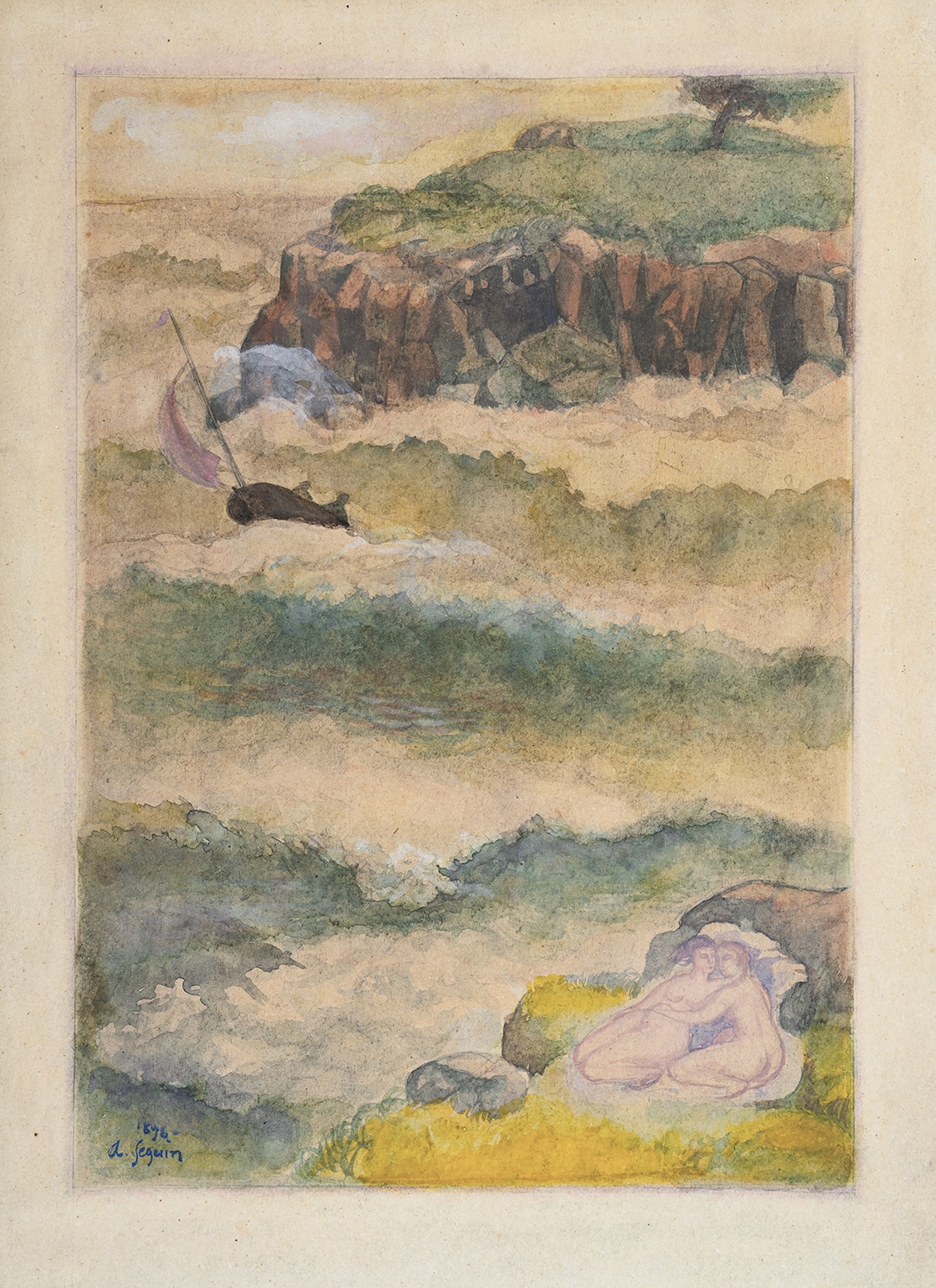
In 1891, he travelled to Pont-Aven and formed a lasting friendship with the Irish artist Roderic O’Conor, who introduced him to etching. In 1893, Seguin established a close relationship with Gauguin, whom he would thereafter regard as his master. Between 1891 and 1896, the artist experienced his most fertile creative period, which was marked by his participation in the 10th and 11th Peintres Impressionnistes et Symbolistes exhibitions at Le Barc de Boutteville in 1895 and 1896. This flourishing phase proved brief: commissions declined, financial pressures increased, and his production slowed, forcing him to turn to modest illustration work. In a letter to O’Conor, he expressed his frustration: “Every day, every night I dream of the paintings that I cannot execute.” Our sheet belongs precisely to the latest stages of this fertile period. On our sheet, figures and landscape emerge without strict contour as diluted pigments diffuse into the paper, while muted greens and earth tones lend the composition its calm, luminous atmosphere. In keeping with the rest of his work produced in 1896, our Bathers reveal his method of building form through translucent washes.
The work was first owned by Paco Durrio, an important artist and key figure of the Nabi circle. Born Francisco Durrio de Madrón, Durrio was closely associated with Paul Gauguin and played an active role in the dissemination of Nabi ideas across painting, sculpture, ceramics, and the decorative arts. A friend and supporter of Seguin, he was also later connected to Pablo Picasso, whom he met in Paris and whose early work he supported. Our drawing subsequently passed to Jean (or Joan) Pié (1890–1977), who arrived from Spain in 1910 and settled in Paris, where he worked closely with Paco Durrio as his student and apprentice. Pié maintained a direct artistic relationship with Durrio, whose practice had a lasting influence on his own work. The work then remained in the artist’s family, passing to his widow Flora Pié upon Jean’s death, and stayed in the same family collection until it was sold at auction in 2025.