A native of Normandy, Albert Lebourg began studying architecture at the École des Beaux-Arts in Rouen at the age of seventeen. In 1872 he left France to teach drawing in Algiers; after several years there, however, he chose to settle in Paris. Upon his return, he joined the studio of Jean-Paul Laurens at the École des Beaux-Arts. Inspired by the northern light and the landscapes of the Norman coast, Lebourg developed a keen sensitivity to atmospheric effects and gradually devoted himself to landscape painting. He soon came into contact with the Impressionists and participated in their exhibitions of 1878 and 1880. The Seine and the Marne became among his favoured motifs, and he divided his time between Rouen, Paris, and the countryside of his native Normandy.
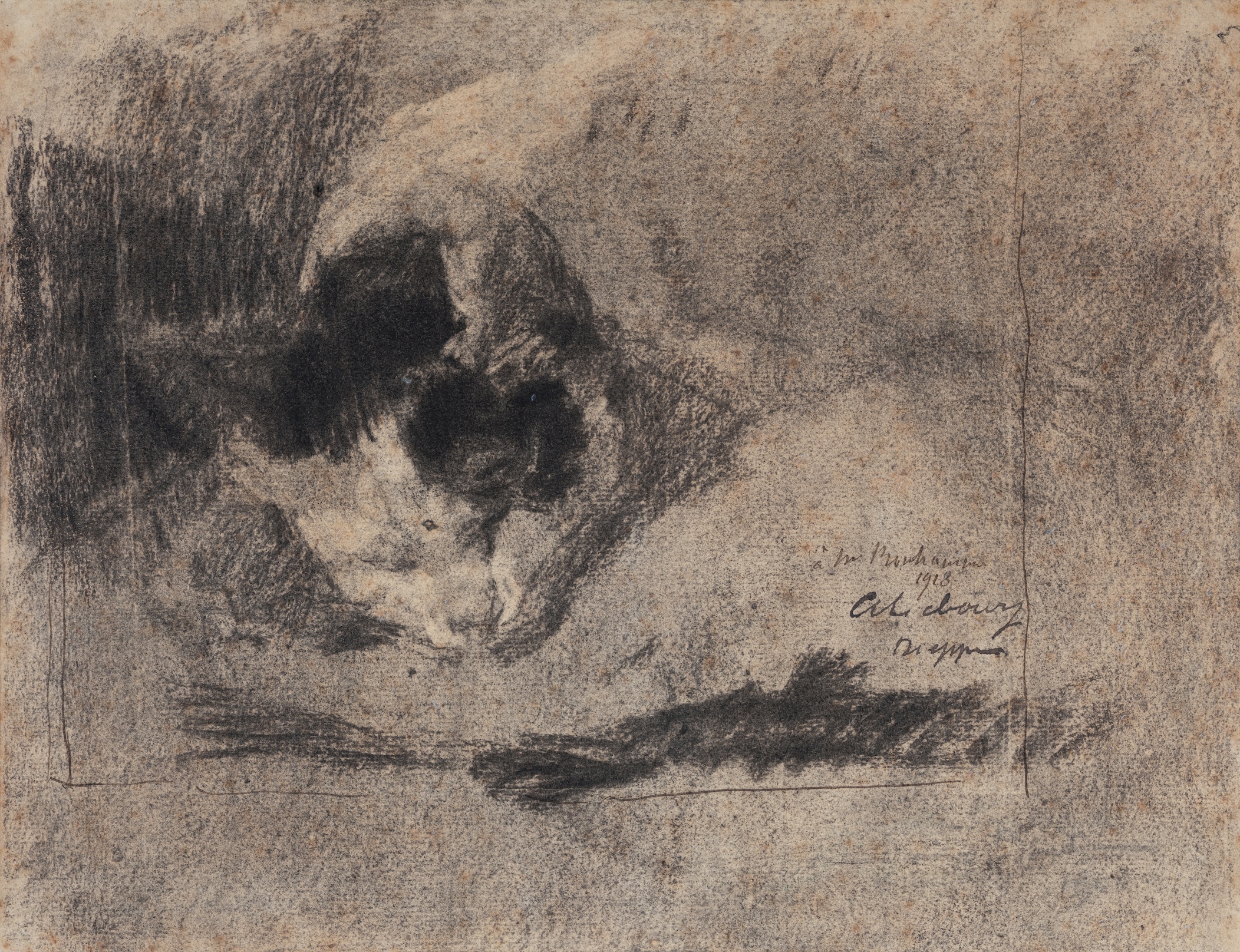
On our sheet, Lebourg renders the head of a sleeping cat in charcoal with the warm tone of the paper deliberately left active to articulate the texture of the fur and the subtle transitions of light across the form. Dense, compact passages contrast with lighter reserves to define the eyes, muzzle, and coat, while darker zones, worked with quick and decisive strokes, establish depth around the head. Lebourg reinforced these effects by rubbing the medium into the grain of the paper, producing carefully modulated chiaroscuro.
In contrast to his Impressionist painting, Lebourg’s draughtsmanship in charcoal, black chalk aligns more closely with the Realist tradition of Gustave Courbet. As indicated by the dedication it bears, our Sleeping Cat was drawn in Dieppe, in Normandy, and was presented to Mr. Bonhomme in 1918. That same year, Lebourg also presented him with another drawing showing several studies of what may be the same cat, identifiable by the dark patch over its left eye (fig. 1). The handling and tonal density of our drawing, however, suggest an earlier moment in the artist’s graphic production, probably dating to the final years of the preceding century, when physical presence and sculptural modelling took precedence over the more atmospheric effects that would come to dominate his later work.