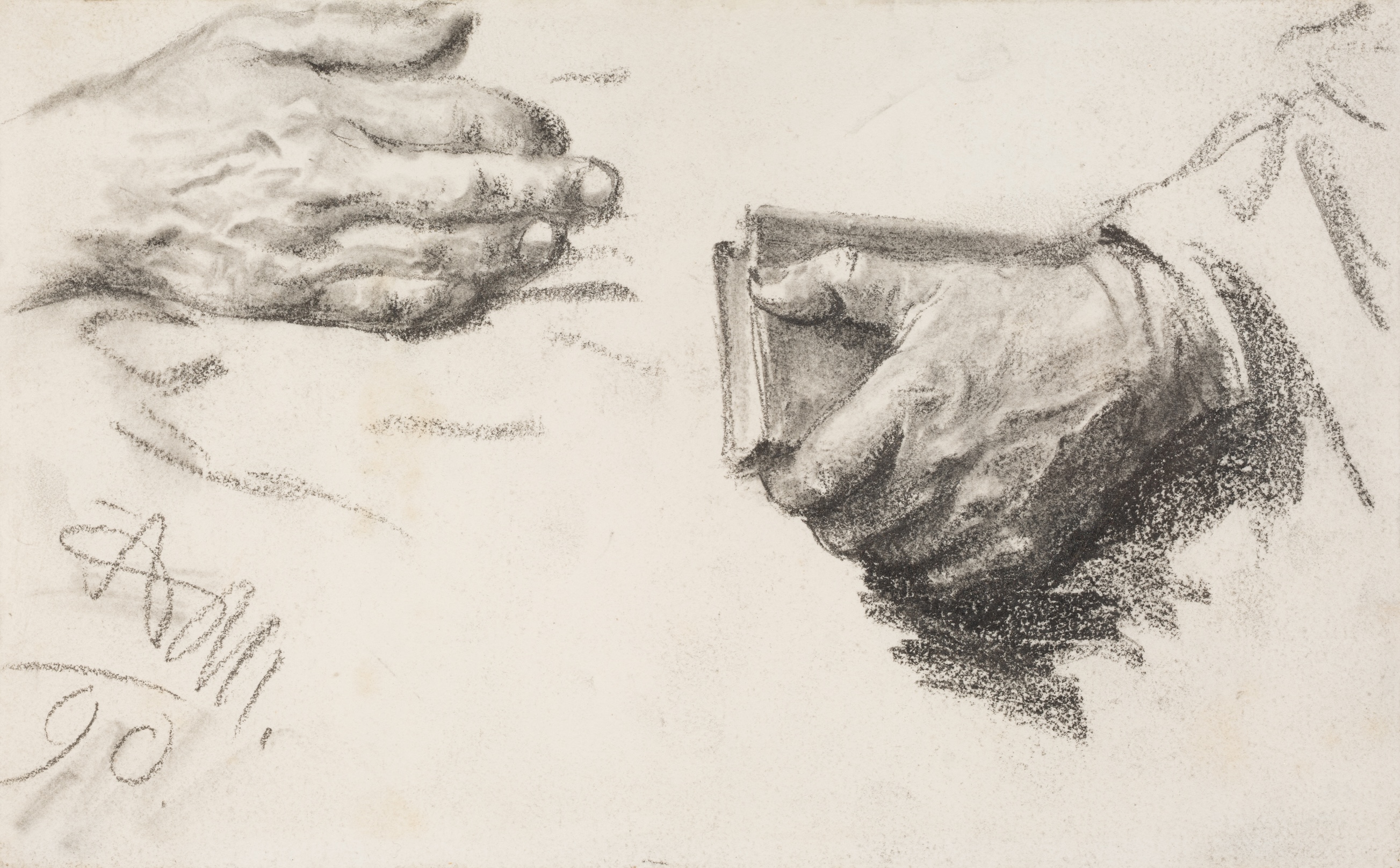
Largely self-taught, Adolph von Menzel came to prominence through his illustrations for Franz Kugler’s History of Frederick the Great, a project that established his reputation for precision and historical acuity. Over the course of a long career based primarily in Berlin, Menzel developed a highly individual form of Realism grounded in sustained study and technical control. His achievements were widely recognised during his lifetime and, in 1898, culminated in his ennoblement. Drawing lay at the core of Menzel’s artistic practice, and throughout his career, and from his earliest years he produced numerous studies in pencil, chalk, pastel, and gouache, treating hands both as autonomous motifs and as essential elements of larger compositions. The opening page of one of his earliest sketchbooks (Kupferstichkabinett, Berlin), dated 1835, already includes several pencil studies of hands holding a book or clasped together.
By around 1890 Menzel worked with increasing independence, largely freed from academic constraints and public commissions. Works from this period reveal a growing focus on fragmentary subjects and isolated motifs, particularly in his works on paper where studies of hands recur frequently. His attention to partial views of the body finds a compelling parallel in his well-known study of his own foot (fig. 1), which encapsulates Menzel’s focus on the unidealised and the overlooked, as well as his sensitivity to the expressive potential of the fragment.
Executed in charcoal in 1890, our Study of Hands combines lightly articulated structural lines with more concentrated passages of shading to define joints, musculature, and the distribution of pressure within the hands. The absence of contextual detail directs attention to the functional and formal aspects of the motif. Both in subject and in handling, our drawing fits squarely within Menzel’s late graphic work and exemplifies his sustained engagement with the study of hands across more than half a century.